
Member Spotlight: The Center for Native Health
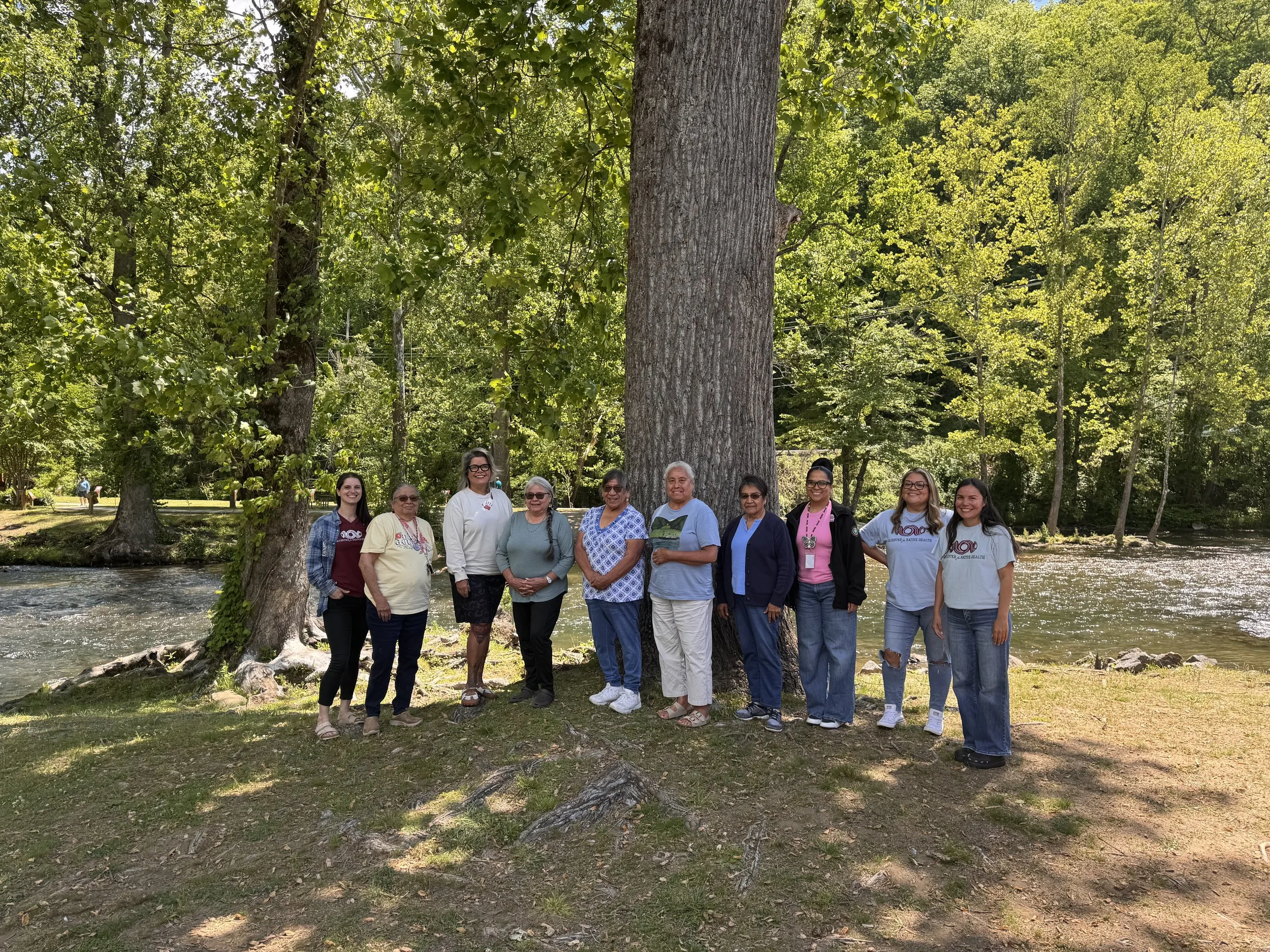
Tell us a little about your work and how the Center came to be.
The Center for Native Health (CNH) is a Native-led, Native-run nonprofit organization dedicated to supporting the balanced wellbeing of southeastern Native communities through the preservation and respectful application of Native knowledge. Situated on the Qualla Boundary of the Eastern Band of Cherokee Indians, CNH is guided by two cultural principals Duyvktv and Tohi, which combine to form an Indigenous structure for understanding health and wellbeing. Our mission is rooted in the understanding that true health encompasses not just the body, but is deeply embedded in our relationship to the land, culture, and community. Through this work we envision a world where Indigenous communities thrive—grounded in culture, rich in tradition, alive with laughter, and collectively shaping a future that honors the past. CNH has four focus areas: 1) Climate, Land and Wellness 2) Relational Health 3) Education & Training and 4) Art, Language and Healing. Projects within each of these programs are guided by Indigenous knowledge systems rooted in traditional ecological knowledge (TEK). These include developing career pathways for Native students in BioMedical fields, supporting culturally aligned doula and birthworker training, working on community land-based healing and food sovereignty, while also focusing on Cherokee artisan knowledge preservation. Through these program areas CNH seeks to disrupt cycles of historical trauma, including health disparities amongst southeastern American Indian people.
What recent accomplishment are you most proud of that reflects your ongoing mission to enhance health equity across North Carolina / Appalachia? Can you share a success story that exemplifies your impact?
Our greatest programmatic success was training 18 Indigenous women to be Doula’s and working with them in culturally relevant ways to support pregnant and expectant mothers. Currently, no Cherokee children are born on Eastern Band of Cherokee Indians held land in present-day North Carolina for various reasons. Therefore, moms are shipped to surrounding facilities, most often, without culturally relevant care. This was our first cohort of doulas and they have now been a part of 18 Cherokee births. Not only are they being trained in Doula care but we are deeply integrating Cherokee culture - song, language, plant knowledge and cultural values - into their knowledge base as birth justice advocates. It’s really beautiful and the fruition of a lifelong dream of several EBCI community members. We have a dedicated, passionate team of Elders, First Languages speakers and community members who believe in this work. We have also been supported by Katsi Cook, a well respected Mohawk Elder and midwife. She has mentored us through the process and provided critical funding via the Spirit Aligned Leadership Program to stabilize and grow the program.
How do you measure your success?
As a Native-led, Native-controlled organization we have come to define our success by the relationships we form and the relationships we sustain. We would not be where we are without the help of Native, Non-Native allies - whether that be volunteers, funders, donors or strategically aligned thinkers. We are at our best when we have the right people, in the right places, at the right time and for the right reasons. When those factors align we are successful. An important framework that Cunderscores this belief is:
duyuktv'i ani yvw'i -- The Right People
Duyugodvi U(h)nai Iyadun(e)diyi - the right place
duyuktv'i iyu'i iyudv(n)d'i - right time/distance
duyuktv'i advned'i- Doing the right thing or right reasons
This way of thinking encompasses our understanding of Tohi, or balance. This framework guides how we understand reciprocal partnerships, appropriate programming, and our commitments to the community. If any of these elements are missing from a relationship or program we understand that things will be difficult and usually won't work out well. We look for allies, funders, donors, volunteers, and ideas that fit this framework.
Where do you see the biggest gaps that funders could help fill? and where do you see hope?
One of our dreams is to build a Cherokee Artist Village, which would be the first of its kind on the East Coast. As a Cherokee person - living and working within our traditional homelands I see the Eastern Band of Cherokee Indians - in North Carolina - as a community of artists. Honestly, I don't know many folks who don't do some form of art, whether it's ceramics/pottery, beading, carving, basket weaving, painting, etc. I think art, from a Cherokee perspective, is an ancestral expression of place. However, besides selling various art forms there is not a current hub for Cherokee artists to explore and make art. We envision a place where Native and non-Native artists can learn with and from each other while stewarding the next generation of artists. This is important in how CNH understands a healthy community from a cultural perspective. We have spent the past three years learning and building a wood fired kiln as an anchor for a Cherokee artist village. SouthArts (an AFN member) was one of our earliest supporters along with the Cherokee Preservation Foundation. We also received unexpected contributions from some local businesses to finish the kiln site. However, finding general operating funds alongside capital funds remains a continuous challenge in the philanthropy world, particularly given that less than 1% of philanthropic dollars make their way into Indigenous communities.
How will being part of the Appalachia Funders Network support or strengthen your work - and where do you see AFN helping to amplify funders’ collective impact in the future?
We are so excited to be a part of AFN. We had a great time at the conference in Ashland, KY. Everyone was really welcoming and supportive. We currently provide micro-grants to community members, this is one of my favorite parts of the job. Seeing funding make a direct impact in the community is really an honor. I hope to grow the pool of money available for community members. Attending the AFN conference really broadened my perspective on how we can think more creatively about leveraging our assets on behalf of Cherokee people. We have already learned a lot and made some powerful connections with AFN members that will hopefully lead to collaborative, reciprocal relationships for years to come.
From conversation with Executive Director, Trey Adcock, PhD