
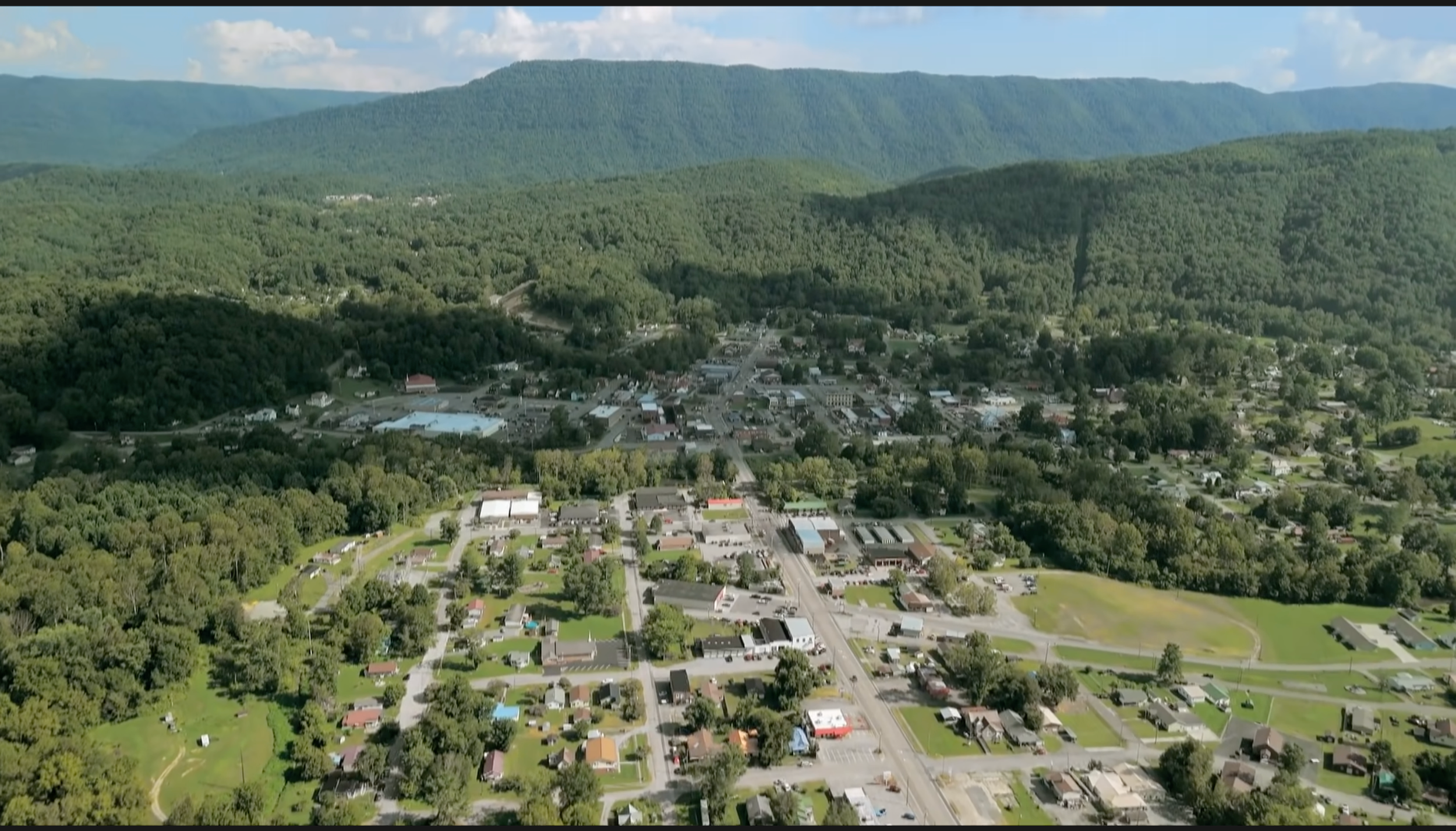
Big Stone Gap, Virginia, is in the state's southwestern coal mining region where miners, their families, and their communities are reeling from high rates of black lung disease. | Credit: Justin Litton for Frontline PBS
Appalachia is known for many things — our vibrant culture, our scenic beauty, the wealth of resources encapsulated and adorning our mountains and valleys — and those of us working toward prosperity in the region know this best of all. Wrapped up in all of this is the power of our stories. and storytellers who, by holding the past for our communities, help us see what is possible for the future.
Through stories, we remember that Appalachia has long been resolute, resourceful, and triumphant, against all odds against the challenges historically set before them.
For many years, this triumph had included largely overcoming the scourge of black lung disease, which plagued miner families for generations. By the late 1990s, rates of new disease had plunged from 30% in the 1970s to only 7%, thanks largely to the passage of legislation such as the Federal Coal Mine Safety Act of 1969.
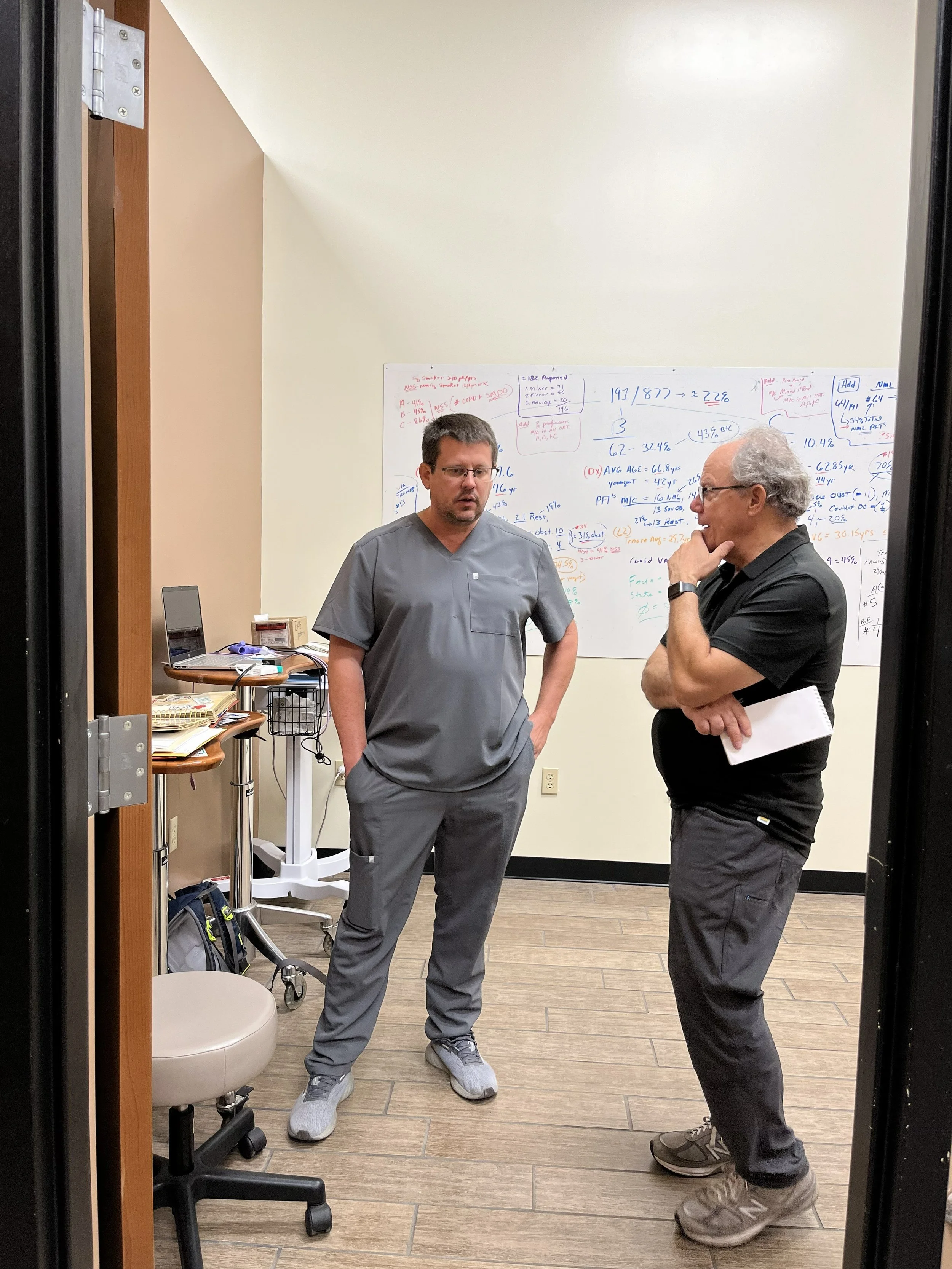
Frontline Correspondent Howard Berkes (R) speaks with Kentucky radiologist Brandon Crum who first raised the alarm about a hidden epidemic of advanced black lung disease. | Credit: Molly Born.
But shortly after that historically low reporting rate, disease began to rise again. And now, rates are the highest they have been in nearly 50 years.
It raises questions of what might come next, and where we go from here. However, if there is any silver lining it is that we have been here before and can learn from the organizers who moved mountains on this front before us.
What’s more, there are storytellers, writers and investigative journalists who are passionate about ensuring these stories and Appalachian voices stay at the fore, who are already on the case. And they’ve been hard at work for awhile.
It’s been over a decade, in fact, since retired NPR correspondent Howard Berkes wrote his first story about the resurgence of black lung disease among miners in Central Appalachia. It all started with a report that came out after the Upper Big Branch mine disaster in 2010.
”There was a little sidebar in the report that noted that the autopsies of the miners who were killed showed an extraordinarily high rate of black lung disease — 10 times higher than the average rate for Southern West Virginia. And that's what got me and another reporter, Chris Hamby from the Center for Public Integrity interested,” Berkes said.
He’s still covering the issue today, most recently in the new Frontline documentary ‘Coal’s Human Cost’. And he’s still not doing it alone.
“I went back and checked, the first time we started working together was 2016, so 10 years, with what you could say was a predecessor to the Appalachia + Mid-South Newsroom, the Ohio Valley Resource,” Berkes said.
Appalachia+Midsouth Newsroom (A+MSN), a member of the Rural News Fund’s current newsroom cohort, is a collaboration of NPR affiliates in Kentucky, Tennessee, and West Virginia.
Justin Hicks is a reporter for A+MSN who covered the story alongside Berkes.
“I was looking for somebody to pass the torch to. And Justin was that perfect person, not only being there in Kentucky, but having an interest in these stories and in black lung and in coal mine safety,” Berkes said.
Their latest story follows several miners, pulmonary doctors, and advocates in Kentucky, West Virginia, and Virginia, who are navigating the impacts of a rise in black lung disease among young coal miners. Miners being diagnosed in the past decade are far sicker and far younger than those who developed the disease in the past. The culprit, research has found, is an increase in silica dust in the mines.
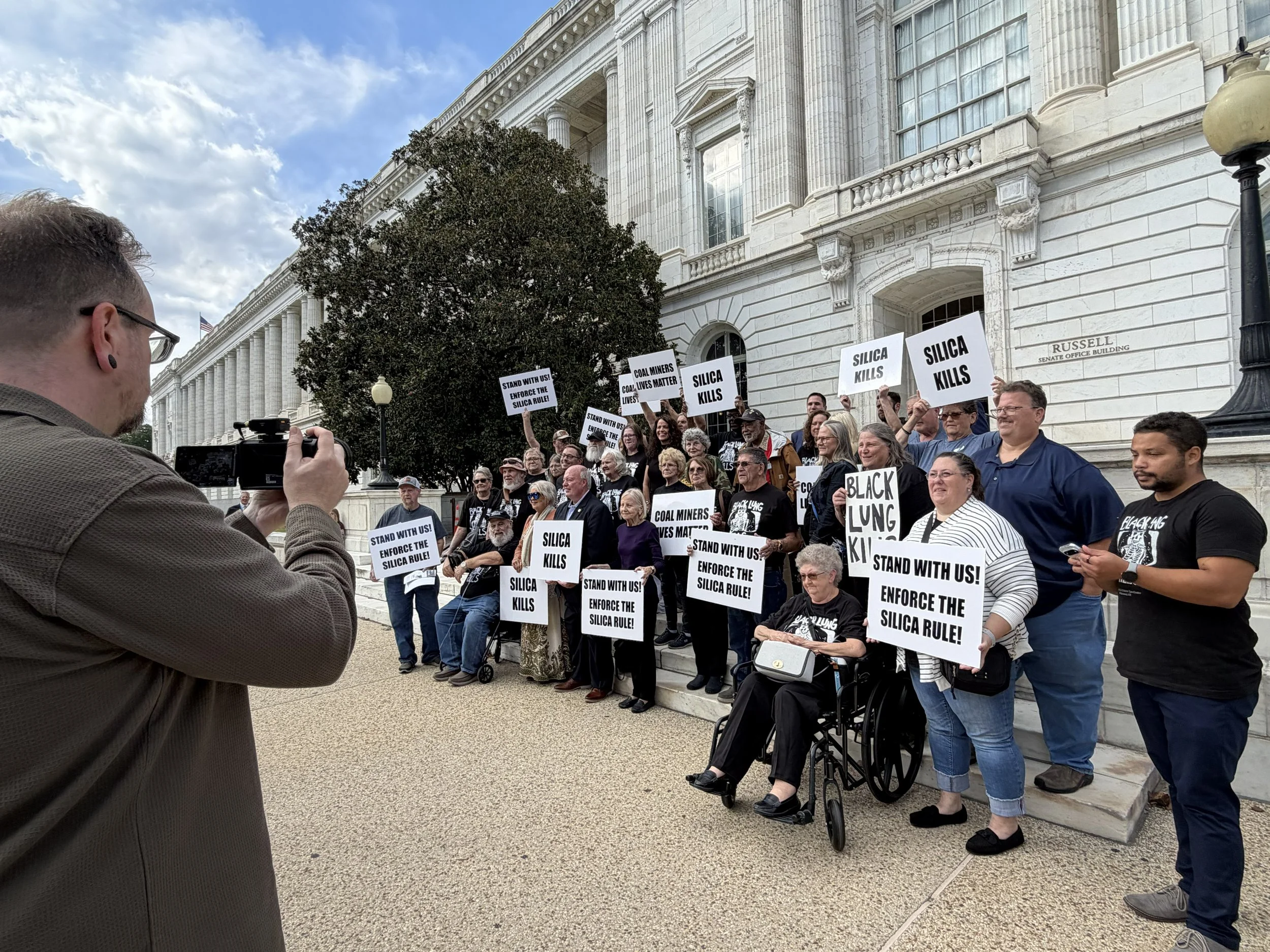
Frontline cinematographer Justin Litton films coal miners with black lung and their advocates during a lobbying trip to Washington, DC. | Credit: Molly Born
The rich, pure coal deposits that once existed in Appalachia have all been mined, Berkes said, leaving thinner coal seams. That means they have to cut more rock to get to the coal, which creates more silica dust.
Understanding the scope of the crisis meant talking to sources across multiple states, reporting that would have been difficult for any one newsroom to tackle alone.
Berkes and Hicks both said the collaborative nature of A+MSN proved a vital part of their work. Although Hicks lives in Louisville, KY and Berkes has been embedded in this reporting since the Obama administration, neither of them are from or live in Appalachia.
But they're not working alone. A+MSN connects journalists and public radio stations across the region, making it possible to cover stories beyond the reach of any one newsroom. Without that regional infrastructure, Hicks said, he wouldn't have the capacity to spend time reporting in Eastern Kentucky and West Virginia, far outside Louisville Public Media's immediate coverage area.
A+MSN Managing Editor Ryan Van Velzer works with reporters based at stations like WMMT in Whitesburg, KY, and West Virginia Public Broadcasting in Charleston, WV (both also grantee partners in the Rural News Fund’s current cohort), as well as reporters like Hicks who spend time in and out of Appalachia.
Behind that reporting is a team of six people working in shared services, including editorial, audience engagement and fundraising. A+MSN Development Director Kate Roselle said those positions are designed to help partner newsrooms work together and make the most of their resources.
“That means that when an opportunity to share resources comes up, we're positioned to maximize that opportunity in reporting, editorial, audience engagement and fundraising, connecting and amplifying the work from our partner news outlets,” Roselle said.
Van Velzer said it can be challenging to communicate to funders from outside the region just how time consuming and resource intensive it can be to report and earn trust here.
“If you're not used to the region, you're like, ‘oh, it's like this far on the map. That'll take me like a half hour.’ And then it's two hours later because it's winding switchbacks up and down mountains to get there,” he said.
Berkes knows what it takes to earn that trust first-hand. He spent years, he said, showing up and showing up again in these impacted communities.
“The moment that you walk up to any source and say, yeah, I'm working with Howard Berkes on this story, they immediately just say, Howard Berkes, and they open up everything for you.” Hicks said.
Berkes said it didn’t start out that way, though.
Appalachia + Midsouth Newsroom reporter Justin Hicks describes what it takes to get to the remaining coal seams in Central Appalachia, and what that type of mining is doing to miners. | Credit: Justin Hicks
“I knew that it's very tough for a reporter to parachute into a place, especially into Appalachia and expect people to talk to you, trust you. There's such a legacy of reporters, national reporters parachuting in, just picking up on the stereotypes of Appalachia and leaving, and that's all they display,” Berkes said. “One thing I did right off the bat while I was investigating Upper Big Branch and later Black Lung, I'd ask people who didn't want to talk to me, ‘do you mind if I get your email and I just send you links to my stories as I do them?’ Almost every one of them agreed to that. So that helped. They could see that I was continuing to report, continuing to travel in the region.”
Hicks, for his part, said his van has turned out to be a huge asset in his own ability to get to Eastern Kentucky, West Virginia, and Virginia more often.
“I get to travel more than some of our other reporters because I don't have to bill for lodging. I just park in people's yards and churches and grocery stores and just sleep in my van,” he said.
Van Velzer said Hick’s travel van has been impactful even beyond the newsroom’s budget.
“He’s made some incredible contacts from spending the night in a Walmart parking lot after a flood or a hurricane and meeting people who were buying supplies and then going with them to muck out their houses,” Van Velzer said. “That's a testament to great reporting, but also a sign that it shouldn't necessarily have to be like that.”
The work is certainly not done.
“We're now seeing with these younger and younger miners. There are young kids in their families. This is a crisis of generations in Appalachia, and they can't walk away,” Berkes said. “The more that we can do and get the support to keep on top of these stories and cover them, we owe that to these people, I think. We, to some degree, shouldn't be able to walk away either, and so it's good that Justin has the support in his newsroom.”
For Hicks, the sustainability of A+MSN is critical in his ability to keep following this story.
“We need AMSN to continue,” Hicks said. “Where I currently, physically sit is at Louisville Public Media (LPM). We don't have a single coal mine in LPM’s broadcast area. So if I was just working for LPM, I would not be doing coal stories. But because LPM has been the hub to house AMSN, because of Kentucky Public Radio and our statewide partnership, I'm able to devote myself to going out to Eastern Kentucky and West Virginia because now it is in my region.”
Roselle said sustaining that capacity will require long-term support, particularly following the loss of the Corporation for Public Broadcasting, which had been a champion of collaborative journalism.
“Regional collaborative newsrooms, like the AMSN, are an important part of the solution for creating resilience in local news outlets. We ensure that our people receive the news about where they live that connects us to one another and amplifies our needs —our voices — across the country,” she said.
In addition to following how the resurgence of black lung progresses and what policies develop (or don’t develop) around it, Hicks has his eye on another investigation.
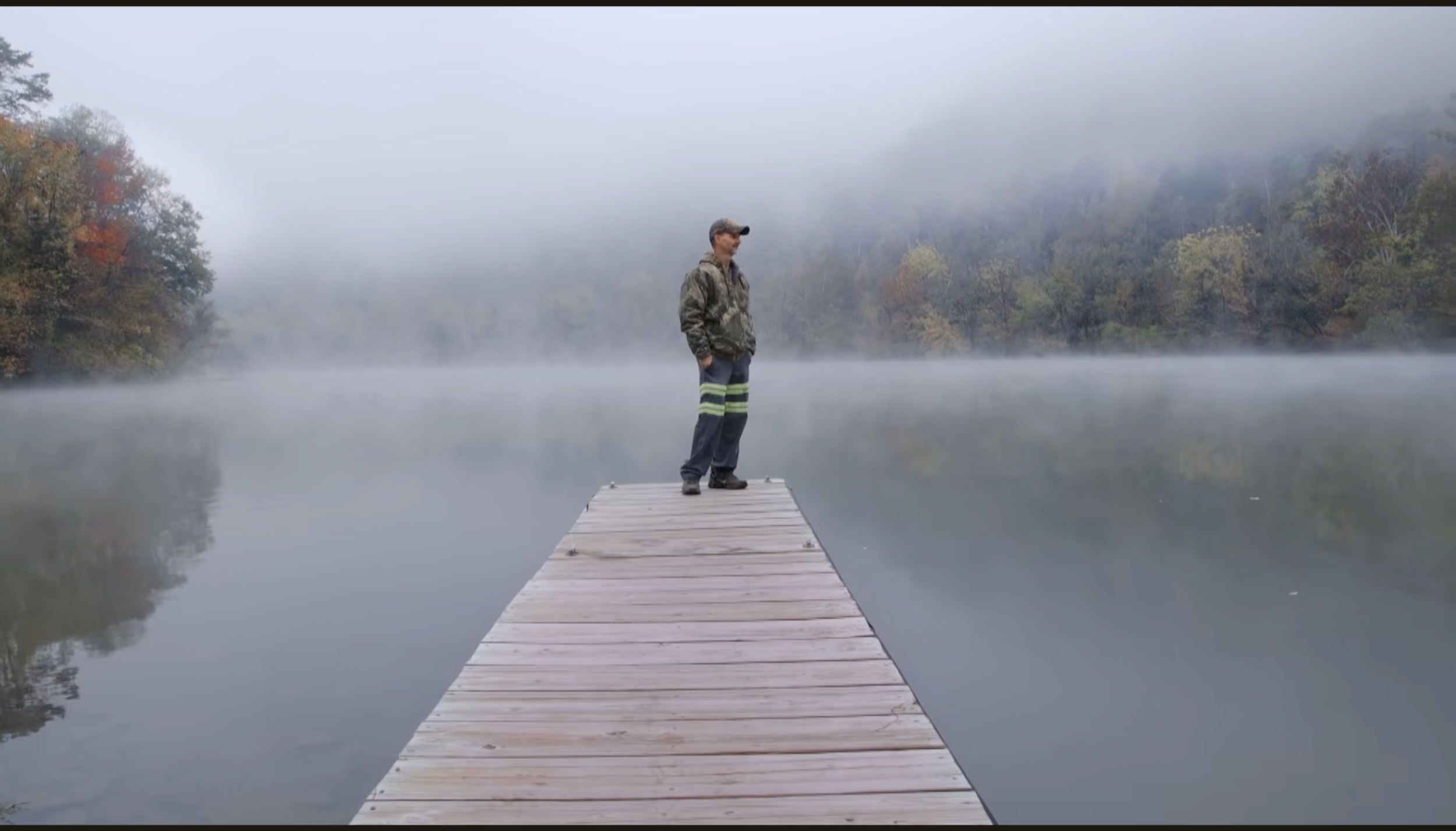
Coal miner Johnathan Wright still wears his reflective miner pants despite losing his job in a layoff last year and being diagnosed with black lung disease. | Credit: Jeff Barklage for FRONTLINE PBS.
While much of the attention has focused on coal miners, he said he's concerned that workers in other kinds of mines may also be developing lung disease from silica dust exposure, with far less research and reporting to reveal the extent of the problem.
Right now, the mining industry as a whole — not just coal companies — are pushing back on rules aimed at reducing the amount of silica dust in the mines. Some of the policies Hicks and Berkes described were slowing down mine machinery, stricter measures on silica dust, and restricting mining of thin coal seams.
“It seems to me like you have an exploding industry on the other side of the issue that no one is really looking at. And it's an industry that's fighting tooth and nail to not be looked at right now.”
He's considered pursuing a fellowship that would give him a year to investigate, but for now, the demands of day-to-day reporting have kept him from digging deeper.
For Berkes, that's another reason the reporting can't stop.
“The reality is, I can walk away. As journalists, we can walk from these stories. These coal miners can't walk away from what they're dealing with. Their families can't, their communities can't.“
To do that, we start picturing newsrooms differently, because it looks many different ways — a guy in the van, camping out in the parking lots of churches and grocery stores. A flurried newsrooms with dogged reporters and cups of black coffee, a stations that make it possible for that guy in the van to report so far away from home and across three states.
It also looks like miners and families who trust that reporter in the van enough to tell him what they’re living through.
And it takes trust. The relationships between the city, the switchback, mountainous roads, and the family’s front porch, that took years to build.
And it takes us. So like Howard, and like Justin, and like many of the families in the communities we love and serve, we do not walk away. We walk forward, together.