
What’s Good in Appalachia? How the Museum of the Cherokee People Centers Native Voices
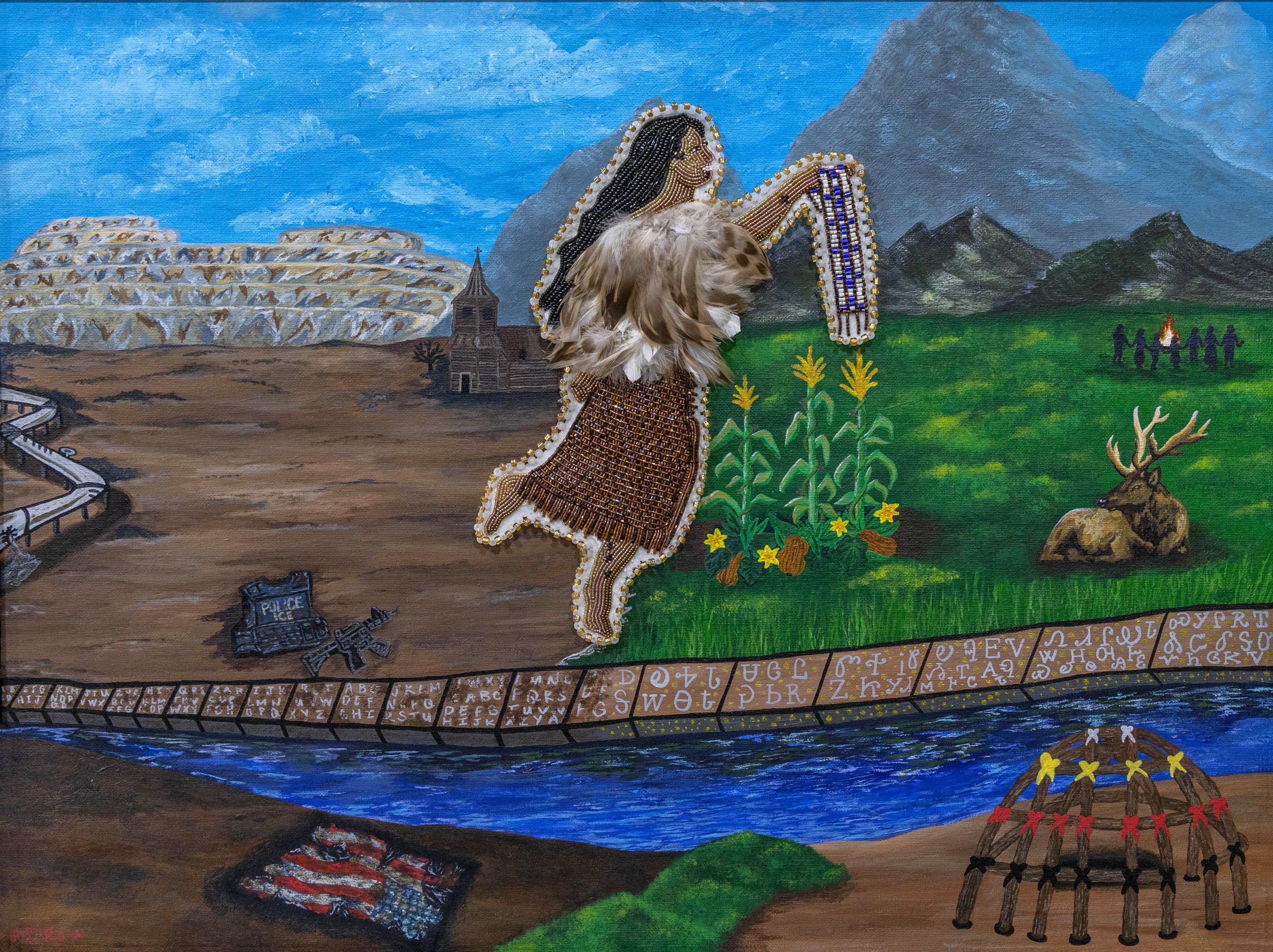
Our Destiny, Manifested, 2026, Canvas, acrylic paint, acrylic pens, hex beads, seed beads, feather, ᏍᎩᎵᎡᏆ Louwana, Jo Montelongo (Eastern Band of Cherokee Indians, b.1999), Loaned Courtesy of the Artist
Shana Bushyhead Condill, Executive Director of the Museum of the Cherokee People, stands in a long, open exhibition space near a wall with five maps. In the middle is the 1884 Royce map of Cherokee land cessions.
“A lot of Cherokee folks know this map, and what it was intended to do was to show the land loss of the Cherokee. What we use it for is to show our ancestral homeland. And so you can see it covers eight states — we're all the way down here in South Carolina, Alabama, all the way up to Kentucky, West Virginia, Virginia,” she says. “Basically, Appalachia.”
Since contact with European colonizers, the Cherokee had been in a constant state of anxiety and battle, she says. Battle for place, for freedom, for home. That’s part of the story Condill said they hoped to tell with their exhibit “Unrelenting,” which marks the 250th anniversary of the US
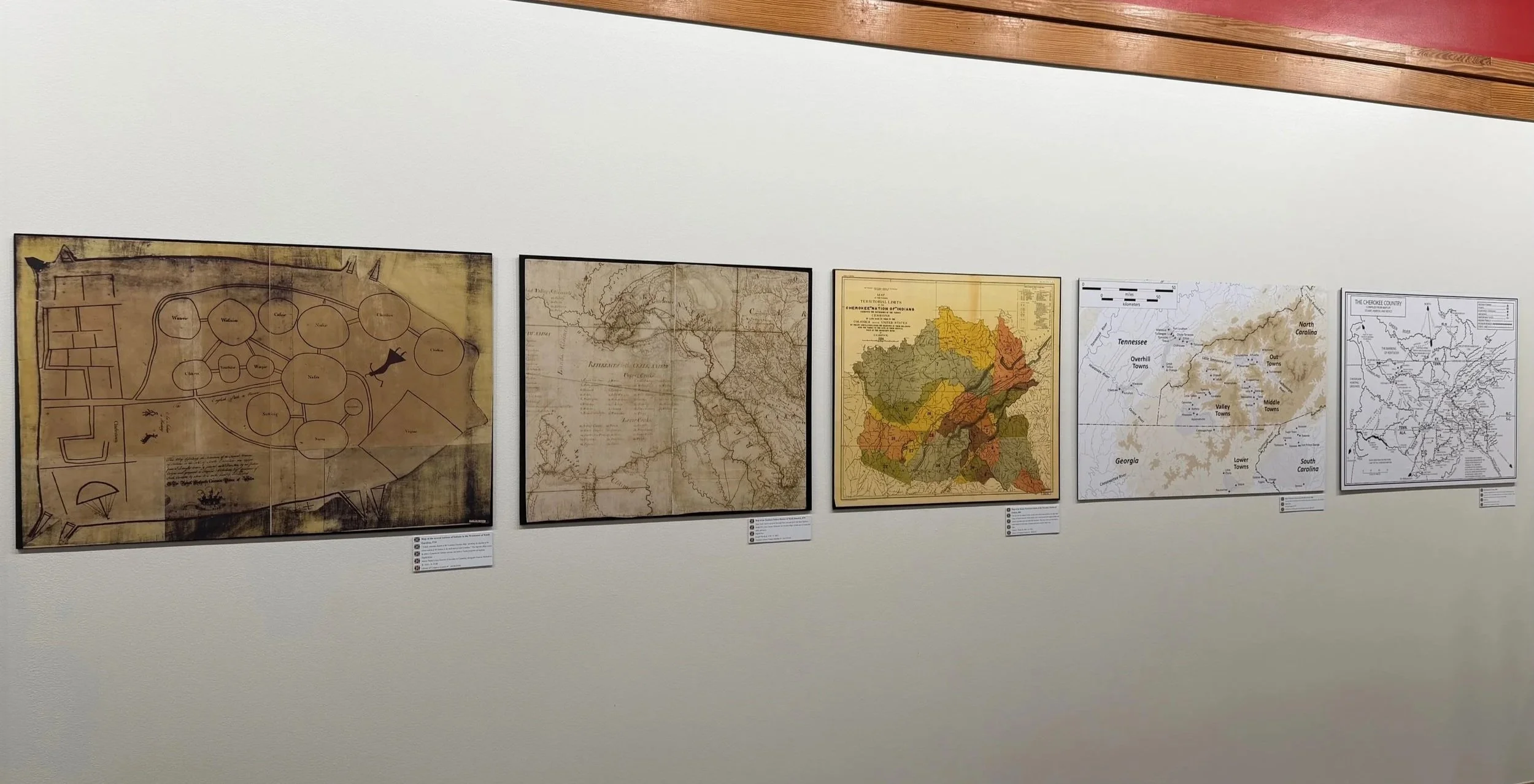
The exhibit includes a series of five maps. “it’s essentially different ways to use maps—for Cherokee people, it’s making maps useful to us. The map on the far left is an example of an Indigenous map. And the Royce map, of course, is a non-Native map meant to show land loss (from a non-Cherokee perspective) that when we apply a Cherokee perspective we use to show ancestral land holdings. And the map on the far right is a Cherokee map based on different sets of knowledge (including the Royce map),” Condill says.
250 years ago when the Declaration of Independence was signed, the Cherokee people knew they were going to need to fight to maintain the sovereignty they had originally been promised, Condill says. They stood to lose thousands of acres of land that the very men whose names were on the document wanted to own for themselves — land that was promised to them in treaties with the government from whom the colonies were now declaring their independence. The Eastern Band of the Cherokee, where the Museum of the Cherokee People sits, consists of 89 square miles — just .07 percent of their ancestral lands.
Condill’s voice weaves between the sound of the Cherokee national anthem that plays from speakers over the entrance to the room.
“Folks had been reaching out and going like ‘America 250’,” she says, flashing celebratory jazz hands. “And we were like ‘ah … something feels weird about that.’”
But they decided to move forward. Unlike many exhibits that mark the 250, this one is fully independent. The museum didn’t take any federal or state funding, a decision she says they made in 2022.
Also unlike many 250 exhibits, this one contains as many if not more works created by modern artists and storytellers as it does items from the past. It’s a reckoning of identity, something that citizens of the Eastern Band do every day.
“As much as we dreaded this commemoration, I think the advantage is that it gives us a moment to consider who we are as Americans and what our ideals are,” she says.
The exhibit fits into the museum’s larger philosophy: rather than just adding Cherokee perspectives to someone else’s telling of history, the museum centers Cherokee people as the experts on their own stories.
It’s a model of the type of work that’s possible when funders trust grantees to make decisions about what’s best for their own communities. Condill said AFN member, The Center for Native Health, has been a powerful partner in their work centering native voices, including funding an event called “The Way We See the World.”
“It’s all about Native self-representation. What does that look like when you have Native people telling Native stories?” Condill says. “The first year we had the idea to do [the event], Center for Native Health was the very first sponsor we had for that event. And they have sponsored every year since.”
She says she and Dakota Brown, the museum’s Director of Education, are both historians. So, they started where most historians would: with secondary sources.
“And there was nothing,” she says.
When they were unable to find anything written about the Cherokee history and perspectives throughout the American revolution, they realized they would need to do that research themselves.
Condill says one thing they knew as they embarked on their research that the part Cherokee women played during the Revolution likely wouldn’t be well documented in the existing secondary sources. But women did play a primary role.
The team sifted through letters, notes, journals, and scraps of paper to piece together the story.
She walks toward the wall immediately left of the door — the first display you are guided toward as you enter the room.
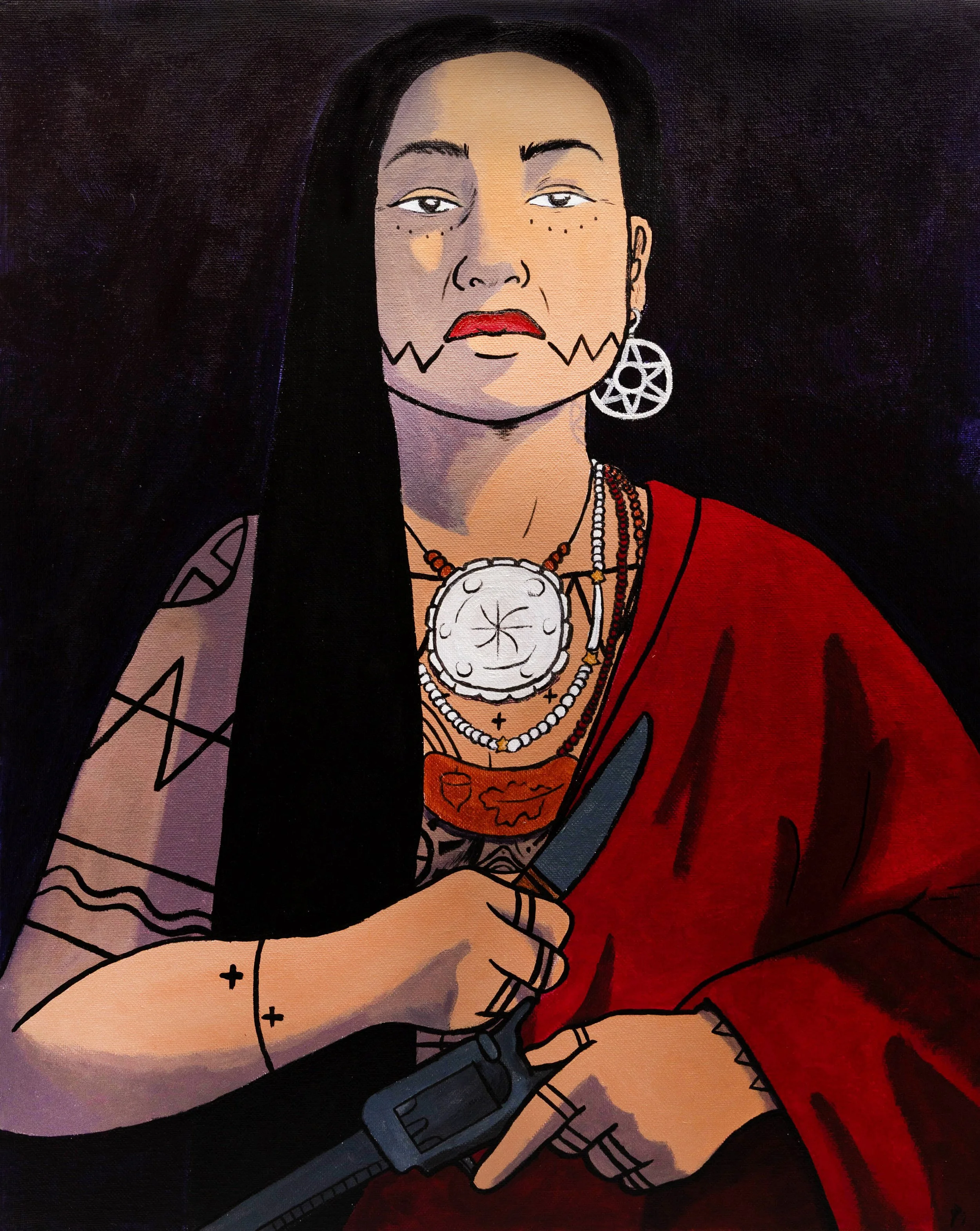
Katteuha Reimagined, 2026
Acrylic, archival ink, canvas panel. ᎨᎳᏗ Keli Gonzales (Cherokee Nation, b.1990), Loaned Courtesy of the Artist
“This section here is meant to restore women back to that conversation,” she says. “There's no way Cherokee folks would have made any decisions about war without women involved. That's just not what happened, and we know that as Cherokee people.”
There’s a lifesize mannequin in traditional Cherokee dress and a black and white t-shirt that says “‘Merciless Indian Savages’ — Declaration of Independence” In the middle of the display is a woven rivercane basket. On the wall to the right is a portrait by artist Keli Gonzales of Katteuha, a Beloved Woman who famously wrote to Benjamin Franklin lobbying for peace between the newly formed United States and the Cherokee people.
“Keli had no idea we were focusing on her, but when she saw that there are multiple examples of portraits done of men during that period, she wanted to bring Cherokee women back into the narrative. The fact that they’re not in secondary sources about the American Revolution is frankly absurd,” Condill said.
Across Appalachia, communities have long had to contend with outsiders telling their stories for them. Condill says she and other citizens of the Eastern Band of the Cherokee share that experience, too, both as Appalachians and as native folks.
Even in their own museum, Condill says, the language in the main galleries is written in third-person.
“Why do we talk about the Cherokee in the past tense? Why are we saying they and them in the labels, right? It means that Cherokee people weren't doing the scholarship that informs those galleries,” she explains.
Now, the Museum of the Cherokee People is transitioning into becoming what they call a “first voice” museum, a term they adopted from the International African American Museum in Charleston.
Condill defines part of that work as making the community their main stakeholder.
“We talk to [the community] about every single thing that we're doing and nothing is done in a vacuum,” she says, adding that it also means they involve the Cherokee worldview in everything they do. “We spent a lot of time doing that from our employee handbook to our collections policy.”
Becoming a first-voice museum also means asking what is for everybody and what is just for Cherokee people.
“Just because you purchased a ticket to come to the museum doesn't give you full access to who we are as Cherokees people because this isn't just a history museum, this is a museum of a living people,” Condill says.
A living people whose experiences are undeniably as Appalachian as they are native. When the community shares what is most important to have communicated in any exhibit, she says ‘place’ always rises to the top.
“My mom always instilled in me this pride of place,” Condill says, her voice tightening as she begins to tear up. “And I feel like, you know, I'm incredibly proud of being Cherokee, but I'm also really proud of being Southern Appalachian.”
That sentiment is echoed in the exhibit. Directly across from the alcove highlighting women’s histories is a beaded bandolier bag created by artist Martha Berry, which she titled “When the Highlands met the Mounds”
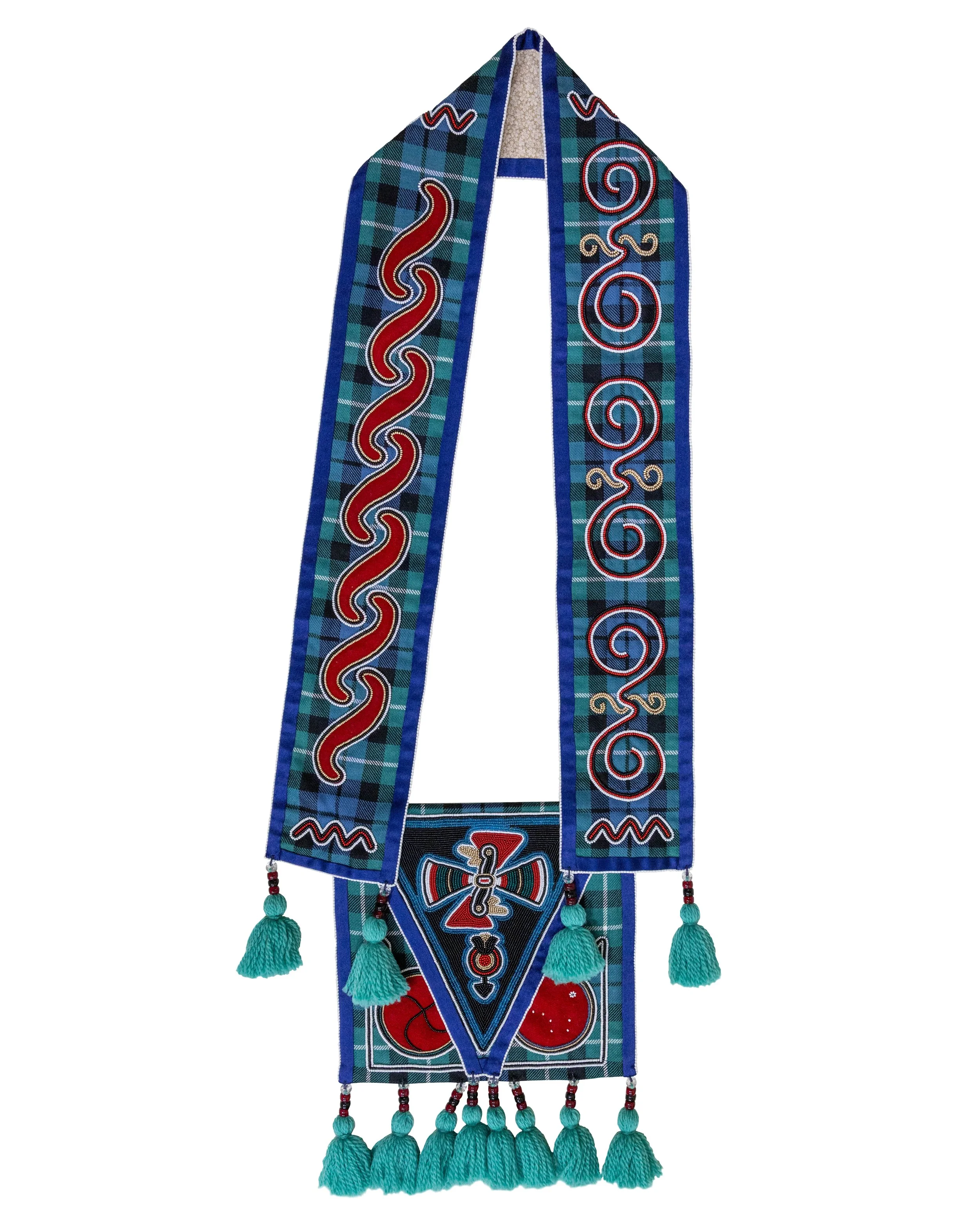
When The Highland Met The Mounds, 2016
Glass seed beads, wool “Graham of Montrose Ancient” clan tartan, cotton, silk, wool yarn, Martha Berry (Cherokee Nation, b.1948), Loaned Courtesy of the Artist
The bead designs are sewn onto a Scottish clan tartan, honoring her family’s Cherokee and Jacobite history. Her artist statement reads “the first Jacobite to marry into my Cherokee family came at the time of the American Revolution. Seven generations later, a descendant of another Jacobite family, the Grahams, turned up in Tulsa almost exactly two centuries later. His family had fled Scotland, moved to Ireland and changed their name, then meandered to Canada, Chicago, Kansas, and finally Oklahoma. In 1972, he met and married this Cherokee girl.”
The bag is a prime example of how they are interweaving stories at the museum, Condill says.
“I think the thing that is dangerous is to only tell stories in a silo. ‘Here's the African-American history, here's the scotch-Irish history…’ well, hang on. Actually we were all interacting, and isn't that interesting?,” she asks. For her, that’s equally as important and part of correcting the narrative about Cherokee people.
For the museum, Condill says, a just transition is best seen through the lens of native futurism. She describes a version of the museum where they are recovering traditional Cherokee knowledge, giving tours entirely in Cherokee as well as English, where all the signage is in Cherokee.
And, she says, that Cherokee people feel less shame for not knowing the language or having to actively relearn it alongside their ceremonies and medicines, and that the museum is a safe place where they can come do that learning.
“A lot of that [history and knowledge] is being held in archives and universities and museums all over the world now. We need all that to come home,” she says.
To get to this version of the future, Condill says, they need freedom to dream.
“The best thing [funders] do is when they're like, we trust you to determine what it is that you need in this moment,” she says. “If you are just struggling to survive day to day, you cannot have a ‘what if’ conversation.”
Condill says that as Cherokee people learn about their history, the impacts are seen through day to day decision-making and in tribal council. And because collective decision making existed in the Americas long before colonial arrivals, this serves as an important reminder for all current inhabitants of the now United States.
"I hope that we are back on a path of hearing and listening to each other," Condill says. "It’s this reciprocal, collaborative type of thinking — this consensus — that’s reflected in the best versions of democracy"
Exhibit Curators & Contributors:
Curators
Dakota Brown (Eastern Band of Cherokee Indians)
Evan Mathis
Guest Curator
Brandon Dillard (Cherokee Nation)
Designer
Tyra Maney (Eastern Band of Cherokee Indians, Diné)
Learn more about the Museum of the Cherokee People
Learn more about the Center for Native Health